What is a Manual Linear Stage and How Does it Work?
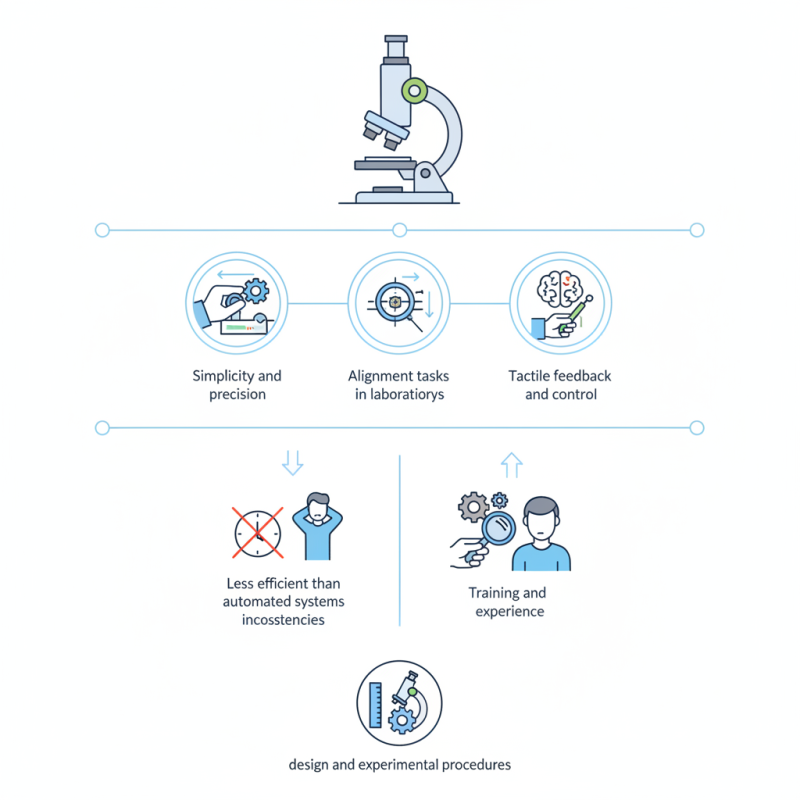
A Manual Linear Stage is a critical piece of equipment in precision engineering and scientific research. According to Dr. Emily Hart, an expert in motion control systems, "The Manual Linear Stage bridges the gap between simplicity and precision." This statement captures the essence of how such stages operate. They offer control over movement in one linear direction, allowing for accurate positioning of components.
These stages are often used in laboratories for alignment tasks. In microscopy, they help position samples with high precision. Users can experience challenges, though. The manual adjustment can be less efficient than automated systems. Still, the tactile feedback often provides a sense of control and direct engagement with the task.
Understanding the Manual Linear Stage is essential for anyone involved in design or experimental procedures. It facilitates intricate work in various fields. However, the reliance on manual intervention might lead to inconsistencies. This aspect highlights the importance of training and experience when using these devices.
What is a Manual Linear Stage and Its Key Components?
A manual linear stage is a precision device used in various industries. It facilitates controlled linear motion, often found in laboratories and manufacturing. The main components include a base, moving platform, and a micrometer or screw mechanism. These elements work together to achieve fine adjustments in positioning.
In a typical application, the accuracy of movements can reach up to 0.01 mm. This precision is crucial for tasks in microscopy and optics. The design allows for easy manual adjustments, making it user-friendly. However, it relies heavily on the operator's skill. Improper handling can lead to inconsistent results.
Tips: Always ensure the stage is free from debris before use. This simple step can enhance accuracy significantly. Regular calibration checks are recommended to maintain precision over time. Remember, even small variations can affect outcomes in sensitive applications.
Principles of Operation: Mechanisms Behind Manual Linear Stages
A manual linear stage is a device that allows precise linear movement along a single axis. It operates using simple mechanical principles. Users manually adjust the position using knobs or levers, providing direct control over the movement. This simplicity makes it popular for various applications, such as in laboratories or manufacturing settings.
The core mechanism behind a manual linear stage often includes lead screws or linear bearings. Lead screws convert rotational motion into linear motion. By turning the screw, the connected platform moves forward or backward. Linear bearings reduce friction, enhancing smooth movement. This combination allows for fine adjustments, which can be critical in applications like alignment or positioning tasks.
However, achieving perfect precision can be challenging. User techniques may vary, leading to inconsistent results. External factors, like vibration, can affect accuracy. Furthermore, wearing parts over time may disrupt smooth operation. Observing these imperfections can lead to improved practices and designs in the future. Each manual linear stage provides lessons in usability and functionality.
Applications of Manual Linear Stages in Precision Engineering
Manual linear stages are vital tools in precision engineering. They allow for controlled movement along a straight line, enabling high precision in various applications. Commonly, they are used to position components with accuracy. This precision is crucial in fields such as robotics and optics. When aligning lenses, for example, slight movements can greatly affect performance.
One of the key applications of manual linear stages is in machining. They help in setting up workpieces for milling or grinding. This setup impacts how parts fit together in assemblies. In experimental setups, these stages allow researchers to manipulate their samples with care. Even a tiny shift can lead to significant variations in results.
Despite their usefulness, manual linear stages do come with challenges. Achieving the desired precision often requires practice and patience. Users might find it difficult to make minute adjustments. Sometimes, it’s not just about the tool but the technique as well. This means that ongoing training can be beneficial to ensure effective use. With dedication, these stages can enhance the quality of work in precision engineering.
Performance Metrics: Speed, Load Capacity, and Stability Considerations
A manual linear stage is an essential tool for precise positioning in various applications. Understanding performance metrics like speed, load capacity, and stability is crucial. Speed affects the efficiency of operations. Typical manual linear stages can achieve speeds of 0.5 to 10 mm/s. However, this can vary based on the method of actuation and design. A stage designed for delicate precision may sacrifice speed for accuracy.
Load capacity is another key factor. Many manual linear stages can handle loads ranging from a few grams to several hundred kilograms. For instance, smaller stages often support loads of around 5 kg, while heavy-duty models can manage up to 500 kg. Users must consider the intended application to select a stage that can safely support its load requirements. However, more load often compromises speed and stability, requiring careful planning.
Stability is vital for maintaining accuracy during operation. A stage with a higher stability rating can consistently deliver precise positioning. Typical stability values can range from 0.01 mm to 0.1 mm under load. External factors, like vibrations and unsteady surfaces, can further impact performance. Reflecting on these metrics helps users make informed choices tailored to their specific needs. Each user's requirements might differ, especially when balancing speed, load capacity, and stability.
Comparison of Manual and Automated Linear Stages in Industry Use
Manual and automated linear stages serve different roles in industrial settings. Manual stages allow precise control through human efforts. Operators have direct touch and feel, enabling fine adjustments. However, this can lead to fatigue or inconsistency over time. Mistakes may arise due to distractions or poor ergonomics.
On the other hand, automated linear stages enhance efficiency. They rely on programmed commands, reducing human error. These systems can handle repetitive tasks without tiring. Yet, they require proper setup and maintenance. Operators may face a learning curve when transitioning from manual to automated systems. Some complex setups can be overwhelming.
Both systems have their place in industry. Manual stages offer reliability in smaller tasks or environments. Automated stages excel in high-volume productions. Understanding their strengths and weaknesses is crucial for optimal use. Users should assess their needs before making a choice. Balancing efficiency and control remains a key consideration.